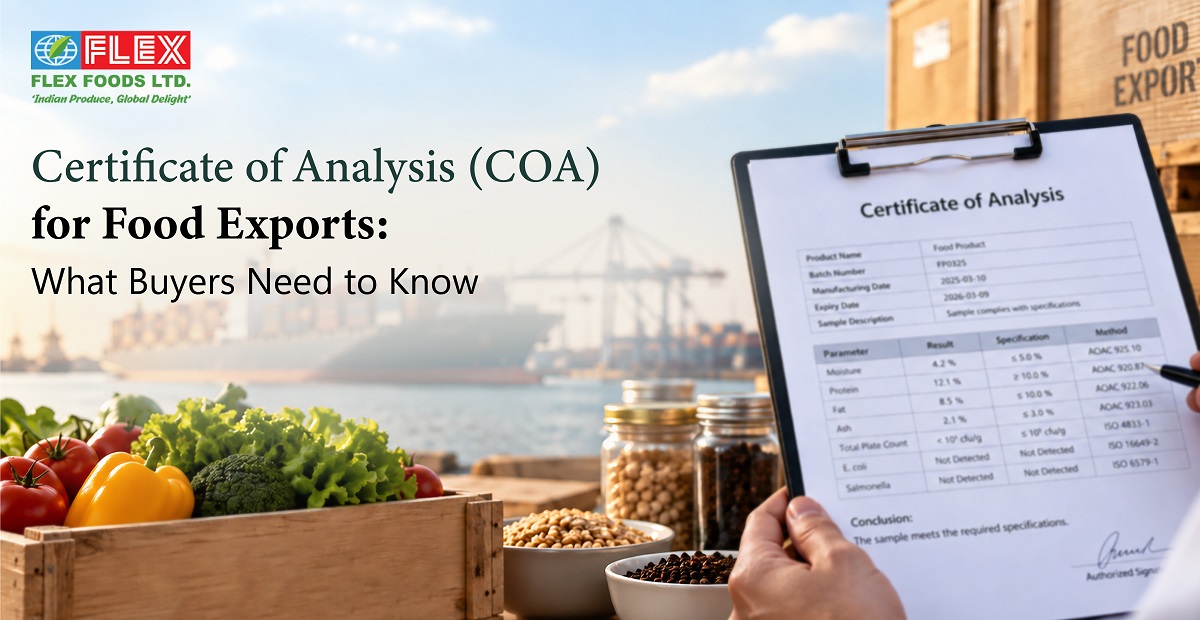
A Certificate of Analysis (COA) is a quality document that reports the results of specified tests performed on a food product or batch. For international buyers, a COA can provide evidence that a product meets agreed specifications for parameters such as microbiological safety, moisture, chemical characteristics, contaminants, or other product-specific requirements.
In international B2B food trade, a COA can play an important role in quality verification. Buyers may use it alongside product specifications, contracts, supplier approvals, audits, and other documentation to assess whether a shipment meets agreed requirements.
For exporters, a well-prepared COA can connect laboratory results to a specific production batch, supporting quality consistency, traceability, and communication between suppliers and international buyers.
Learn more about what blanching vegetables mean?
What Is a Certificate of Analysis (COA) for Food?
A Certificate of Analysis is a document that presents analytical test results for a particular product or batch. It normally compares measured results with defined specifications or acceptance criteria.
The exact content varies according to the food product, customer requirements, testing program, and destination market.
What Information Does a COA Provide?
A food COA may include:
- Product identity
- Batch or lot number
- Sample information
- Production date
- Testing date
- Test parameters
- Test methods
- Specification limits
- Actual test results
- Units of measurement
- Laboratory details
- Accreditation information where relevant
- Approval or authorised sign-off
The document should make it clear what was tested, which batch the result applies to and how the result compares with the relevant specification.
What Does GLOBALG.A.P. Cover?
The IFA framework covers key areas such as:
- Food safety
- Environmental responsibility
- Worker health, safety and welfare
- Animal health and welfare where applicable
- Production processes
- Farm management
- Legal and management requirements
- Traceability
Is a COA the Same as a Food Safety Certificate?
No. A COA is an analytical report, while other export documents serve different purposes.
COA ≠ Certificate of Free Sale ≠ Health Certificate ≠ Certificate of Origin ≠ Certificate of Conformity
A COA reports test results. A Certificate of Origin establishes the origin of goods. A health certificate may provide official certification relating to health requirements, while a Certificate of Free Sale or Certificate of Conformity serves its own specific purpose.
The exact terminology and documentation requirements depend on the product, destination country, and applicable authority.
Read more about the Food Export Compliance
Why Do International Food Buyers Ask for a COA?
To Verify Product Quality
A COA gives buyers analytical information about a specific batch. This allows them to compare measured characteristics with the agreed product specification.
For example, a buyer sourcing dried fruit may have defined limits for moisture, microbiological parameters, and other quality characteristics.
To Confirm Food Safety
Depending on the product, testing may cover microbiological or chemical parameters relevant to food safety.
A COA can provide supporting analytical evidence, but it should not be treated as a complete guarantee of food safety. Food safety depends on the broader production, sanitation, HACCP, traceability, storage and quality-management systems.
To Verify Contract Specifications
Food manufacturers often purchase ingredients against detailed specifications. A COA can demonstrate whether the tested batch falls within those agreed limits.
To Support Import Documentation
Some products and markets may require analytical information as part of import controls or buyer documentation. The exact requirements vary by destination and product.
To Assess Supplier Reliability
Consistent, accurate COAs can help buyers evaluate how a supplier manages testing and quality documentation over time.
To Support Batch Traceability
The batch or lot number provides an important link between the laboratory result and the physical product.
A buyer can potentially connect the COA to production records, packaging information, shipment documents, and other traceability records.
What Should a Food Export COA Include?
A buyer should be able to understand the document without having to guess which product or batch it represents. For international trade, consistency is particularly important. The product name and batch number on the COA should correspond with relevant production, packaging and shipping documentation.
Common Testing Parameters Included in Food COAs
A COA does not necessarily contain every possible food test. The appropriate parameters depend on the product, processing method, customer specification, and destination-market requirements.
Microbiological Testing
Potential microbiological parameters include:
- Total Plate Count
- Yeast and Mold
- Coliforms
- E. coli
- Salmonella
- Listeria
- Other relevant microorganisms or pathogens
The required tests can differ significantly between fresh, frozen, dried, and processed foods. For example, a product with low moisture may require a different testing program from a high-moisture ready-to-eat food.
Physicochemical Testing
Depending on the product, physicochemical analysis may include:
- Moisture
- Water activity
- pH
- Acidity
- Total soluble solids
- Ash
- Bulk density
Moisture and water activity can be particularly important for dried and freeze-dried products because they influence storage stability, texture, and product quality.
This can be relevant when exporting products such as freeze-dried mango, where moisture specifications can be important to maintaining the intended product characteristics.
Chemical and Contaminant Testing
Potential tests include:
- Heavy metals
- Pesticide residues
- Mycotoxins
- Other contaminants
- Product-specific chemical parameters
Not every product requires every test. The testing plan should be based on applicable regulations, customer specifications and identified food-safety risks.
Nutritional Analysis
Where relevant, nutritional analysis may include:
- Protein
- Fat
- Carbohydrates
- Fibre
- Energy
- Vitamins
- Minerals
Nutritional analysis is not necessarily part of every routine batch COA. It may instead be provided through a separate nutritional specification or laboratory report.
Product-Specific Quality Parameters
For processed food ingredients, additional parameters may be relevant to:
- Freeze-dried fruits
- Freeze-dried vegetables
- IQF products
- Dehydrated foods
- Air-dried ingredients
- Herbs
- Fruit ingredients
- Vegetable ingredients
For example, manufacturers purchasing frozen vegetables in India may have specific requirements covering cut size, appearance, microbiological quality, temperature control and other product characteristics.
Who Issues a Certificate of Analysis?
A COA can be issued based on testing performed by different types of laboratories, depending on the buyer and applicable requirements.
Manufacturer's Quality-Control Laboratory
A food manufacturer may operate an internal laboratory that performs routine quality testing. The laboratory can generate analytical reports for batches tested under the company's quality system.
Third-Party Testing Laboratory
An independent laboratory may test samples and provide analytical results. Buyers may request third-party testing where independent verification is important.
Accredited Laboratory
An accredited laboratory operates under a recognised accreditation framework for defined testing activities.
Buyer-Specified Laboratory
Some buyers may specify a particular laboratory, testing facility or testing methodology as part of their procurement requirements.
The appropriate approach depends on the product, destination market, contract and type of test.
Recommended read : Thaw meaning in cooking
COA Requirements for Different Food Export Markets
There is no single COA format that automatically satisfies every international market.
United States
Food imports into the United States are subject to requirements administered by agencies including the FDA and, depending on the commodity, other federal authorities.
Testing and certification requirements can vary according to the product and circumstances. Exporters and importers should identify the requirements applicable to the specific food rather than assuming that one universal COA is mandatory.
European Union
Food entering the European Union must comply with applicable food-safety and import-control requirements.
Certain products subject to enhanced official controls can have specific analytical and laboratory requirements. Where regulations require testing by an accredited laboratory, the applicable accreditation and testing method should be confirmed before shipment.
United Kingdom
Food exporters supplying the UK need to consider the requirements applicable to the specific food product, origin, destination and import route.
Buyers may also impose additional contractual testing and documentation requirements.
Middle East Markets
Markets such as:
- UAE
- Saudi Arabia
- Qatar
- Oman
may have different requirements depending on the food category and importing authority. Exporters should confirm current requirements with the relevant authority, importer and buyer before preparing shipment documentation.
Other International Markets
Exporters may also supply markets such as:- Australia
- Canada
- Japan
- Southeast Asia
Each market can have its own import controls, food standards and documentation requirements.
For this reason, a COA should be prepared against the requirements applicable to the specific transaction rather than treated as a universal export certificate.
Does Every Food Export Shipment Need a COA?
Not necessarily.
Whether a COA is required depends on the product, importing country's regulations, buyer specifications, contractual requirements and circumstances of the shipment. Some buyers may request a COA for every lot, while others may establish periodic or product-specific testing requirements.
Exporters should confirm the documentation requirements before shipment rather than assuming that every international food consignment requires the same certificate.
How Do COAs Support Food Traceability?
A COA can become an important link in a broader food traceability system.
A typical chain may look like:
Raw Material → Production Batch → Finished Product → COA → Packaging → Shipment → Buyer
The batch or lot number can connect:
- Raw materials
- Production records
- Laboratory samples
- Analytical results
- Finished products
- Packaging records
- Warehouse records
- Shipment documents
- Customer information
For example, if a buyer raises a question about a particular shipment, the exporter can use the batch number to locate the relevant production and analytical records.
This makes the COA more than a standalone document. It becomes part of the information trail associated with a specific product batch.
COA and Food Recall Management
A COA can also support food recall and crisis-management processes.
When an analytical result identifies a potential issue, the relevant batch can be investigated using production and traceability records.
COA information can support:
- Identifying affected batches
- Reviewing analytical history
- Investigating deviations
- Supporting root-cause analysis
- Communicating quality information
- Reviewing related shipments
However, a COA is only one component of a broader food-safety and traceability system. It does not replace HACCP procedures, supplier controls, sanitation programs, production monitoring, traceability records or recall procedures.
Common Mistakes in Food Export COAs
- Mistake 1: Incorrect Batch Number
A mismatch between the COA and shipping documents can make it difficult to establish which product was tested. - Mistake 2: : Product Name Doesn't Match Shipping Documents
The product name should be consistent across the COA, invoice, packing list and other relevant documentation. - Mistake 3: Missing Test Method
A result without a clearly identified test method can make interpretation and comparison more difficult. - Mistake 4: Missing Units
A numerical result has little meaning without its measurement unit. - Mistake 5: No Specification Limits
A COA should clearly indicate the applicable specification or acceptance criterion where relevant. - Mistake 6: Using Outdated Test Results
Testing should correspond to the appropriate batch and testing requirements. An old result should not automatically be presented as evidence for a different production lot. - Mistake 7: Testing Doesn't Match Buyer Requirements
A supplier may perform routine tests that do not cover the specific parameters requested by the buyer. - Mistake 8: Missing Laboratory Information
The document should identify the laboratory responsible for the reported analysis where applicable. - Mistake 9: Inconsistent Dates
Production, sampling, testing and reporting dates should be accurate and internally consistent. - Mistake 10: Treating a COA as a Universal Export Certificate
A COA reports analytical results. It does not automatically replace health certificates, certificates of origin, certificates of conformity or other official documents that may be required.
Conclusion
International food buyers need more than a product description when evaluating ingredients and finished foods. They need reliable information that connects a shipment to its quality specifications, production batch and analytical results.
This is particularly relevant for processed food ingredients supplied to international manufacturers. Whether a company is sourcing freeze-dried food in India, dried fruit ingredients, frozen vegetables or other processed agricultural products, clear specifications and reliable analytical documentation can make supplier evaluation more transparent.
For Flex Foods Limited, quality consistency, food-safety controls, traceability and export documentation can form the foundation of a reliable B2B ingredient supply chain. A buyer-ready COA is one practical part of that system, helping connect product quality with the batch, testing process, and shipment supplied to the customer.
Frequently Asked Questions
What is a Certificate of Analysis in the food industry?
A Certificate of Analysis is a quality document that reports analytical test results for a specific food product or batch. It can include microbiological, physicochemical, chemical or other product-specific parameters. Results are generally presented alongside specifications or acceptance criteria so buyers can assess whether the tested batch meets agreed requirements.
Why is a COA important for food exports?
A COA provides buyers with batch-specific analytical information that can support quality verification. It can help demonstrate that relevant parameters meet agreed specifications and can connect laboratory results with production and shipment records. However, a COA is only one part of a broader food-safety and quality-management system.
What information is included in a food COA?
A food COA may include the product name, batch number, sample identification, production and testing dates, test parameters, analytical methods, specifications, actual results, units, laboratory information and authorised approval. The exact format varies according to the product, buyer requirements, testing program, and destination-market requirements.
What tests are commonly included in a food COA?
Common tests can include microbiological parameters such as Total Plate Count, yeast and mold, E. coli, and Salmonella. Depending on the product, a COA may also include moisture, water activity, pH, heavy metals, pesticide residues, or other contaminants. The required testing should be determined by product and market requirements.
Is a COA mandatory for food exports?
Not for every food export shipment. The requirement depends on the product, importing-country regulations, buyer specifications, and contractual conditions. Some buyers may require a COA for every production lot, while others may establish periodic testing schedules. Exporters should confirm the applicable requirements before shipment.
