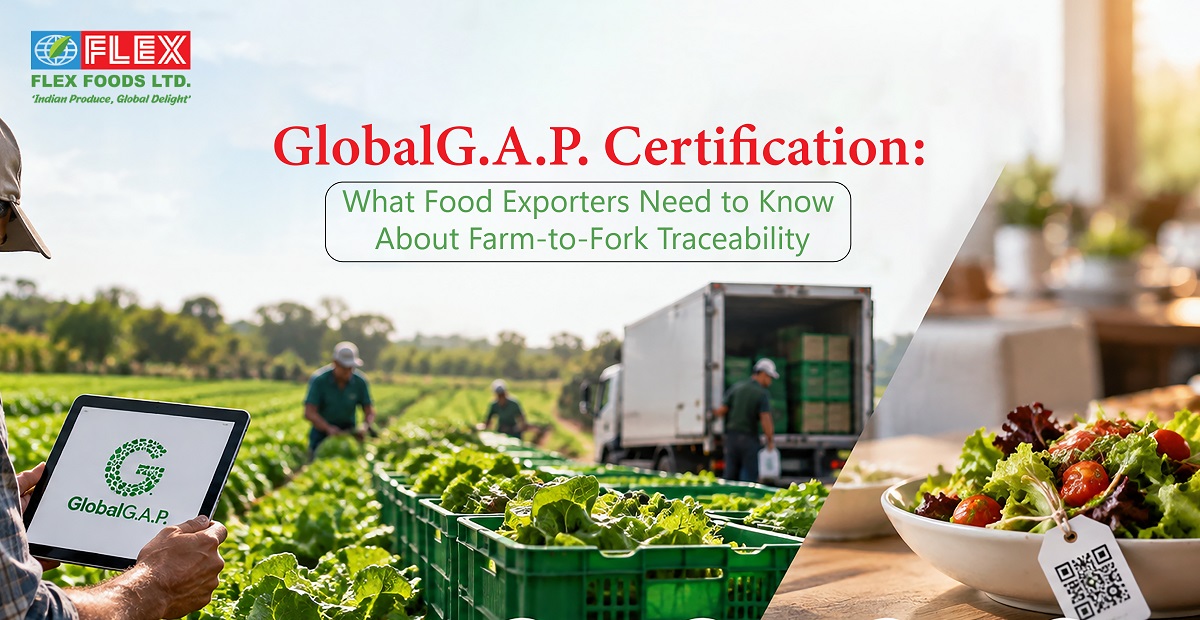
For international food exporters, traceability is no longer limited to knowing where a shipment was packed. Buyers increasingly want visibility into where agricultural products were grown, how they were handled, whether certified and non-certified products were kept separate, and how each batch moved through the supply chain.
GLOBALG.A.P. certification for food exporters provides a framework for responsible agricultural production that covers food safety, environmental management, worker health and welfare, production processes, and traceability. Its Chain of Custody (CoC) standard extends this focus into the supply chain by addressing identification, segregation and traceability of products originating from GLOBALG.A.P.-certified production processes.
For exporters, this creates a traceability pathway that can connect:
Farm → Collection → Packing → Processing → Storage → Export → Importer → Distributor → Retailer
The objective is not simply to hold a certificate. It is to maintain reliable information about the product as it moves through multiple stages.
Learn more about the SEDEX Certification
What Is GLOBALG.A.P. Certification?
GLOBALG.A.P. is a global farm-assurance system developed to provide assurance around responsible agricultural production. Its flagship Integrated Farm Assurance (IFA) standard addresses multiple areas of farm management and production rather than focusing on a single issue.
For food exporters, the important point is that GLOBALG.A.P. operates at the production level, while additional supply-chain requirements can apply after products leave the farm.
What Does GLOBALG.A.P. Cover?
The IFA framework covers key areas such as:
- Food safety
- Environmental responsibility
- Worker health, safety and welfare
- Animal health and welfare where applicable
- Production processes
- Farm management
- Legal and management requirements
- Traceability
GLOBALG.A.P. describes IFA as a holistic approach to responsible farming, with traceability forming part of its core requirements.
Why Is GLOBALG.A.P. Important for International Food Trade?
International buyers often need consistent information about their suppliers and agricultural sourcing practices. Certification can help buyers identify producers that meet the applicable requirements of a recognised assurance system.
For exporters, this can support supplier qualification, transparent sourcing, traceability and responsible-sourcing programs. However, certification should not be presented as an automatic guarantee of access to every international market. Import requirements, customer specifications and destination-country regulations still need to be assessed separately.
What Is Farm-to-Fork Traceability?
Farm-to-fork traceability means being able to establish the history and movement of food through the relevant stages of its supply chain.
A typical export chain can look like this:
Farm → Harvest → Collection → Packing → Processing → Storage → Shipment → Importer → Distributor → Retail
The records maintained at each stage help establish where a product came from, what happened to it, and where it went.
How Does GLOBALG.A.P. Support Farm-to-Fork Traceability?
Traceability begins at production but becomes increasingly important as products move through the supply chain.
- Farm-Level Identification
The starting point is identifying the producer and relevant production activities. GLOBALG.A.P. certification systems use unique identification numbers to connect certification information with the relevant legal entity. - Production Records
Farm records can provide information about production activities, inputs, harvesting and other relevant operations. These records create the foundation for establishing product history. - Harvest and Handling Records
Harvest information can be connected with quantities, dates, products and production areas. When the product moves to another operator, corresponding receiving records can continue the traceability chain. - Product Identification
Products need to remain identifiable as they move through handling, storage, processing and distribution. Clear product identification reduces the possibility of errors and misidentification. - Batch/Lot Traceability
Batch and lot numbers help exporters connect finished products with raw materials, processing records, storage information and shipments. - Supply-Chain Documentation
Invoices, delivery records, receiving documents, production records, inventory information and shipping documents can collectively create an auditable trail. - Chain of Custody
This is where GLOBALG.A.P. CoC becomes particularly important. CoC establishes requirements around segregation, identification, and traceability so the integrity of products originating from certified production processes can be maintained throughout the supply chain.
Certified Farm → Certified Supply Chain → Traceable Product → Verified Buyer
Read more about the halal certification
What Is GLOBALG.A.P. Chain of Custody (CoC)?
GLOBALG.A.P. Chain of Custody is a supply-chain standard designed to protect the integrity of products originating from GLOBALG.A.P.-certified production processes.
It addresses the segregation, identification and traceability of those products throughout their journey. The standard can apply to supply-chain businesses such as packers, processors, traders, brokers, logistics companies and retailers handling relevant certified products.
What Are the Benefits of GLOBALG.A.P. Certification for Food Exporters?
- Builds Buyer Confidence
Certification can provide buyers with structured information about production practices and applicable requirements. - Supports Transparent Sourcing
Exporters can demonstrate greater visibility into the agricultural origins and supply-chain handling of products. - Strengthens Traceability
Documented product and batch information can make it easier to trace materials through production and distribution. - Supports Supplier Approval
Some buyers use certification status as part of their supplier qualification and sourcing requirements. - Helps Manage Supply-Chain Risk
Clear identification, segregation and documentation can reduce risks associated with substitution, misidentification and traceability gaps. - Supports International Market Requirements
GLOBALG.A.P. certification can align with requirements or expectations established by certain buyers and supply chains. Exporters should still review the exact requirements of each destination market. - Strengthens Responsible-Sourcing Credentials
The broader IFA framework addresses environmental, worker and production considerations alongside food safety and traceability.
What Do International Food Buyers Look for in GLOBALG.A.P. Certified Supply Chains?
Buyers may evaluate:
- Valid certification
- Producer identification
- Product scope
- Certification status
- Traceability procedures
- Segregation controls
- Supplier records
- Processing controls
- Applicable food-safety certifications
- Batch and lot identification
- Documentation
The exact requirements vary by buyer, product and market. A supplier should therefore understand the customer's specification rather than assuming that one certification satisfies every requirement.
How Can Buyers Verify GLOBALG.A.P. Certification?
Buyers should use GLOBALG.A.P.'s verification systems rather than relying only on a certificate PDF supplied by a vendor.
The process can broadly be described as:
Obtain GGN → Search Verification Platform → Confirm Status → Check Scope → Verify Validity
GLOBALG.A.P. assigns a 13-digit identification number to registered entities in its certification system. A GGN identifies a producer, while a CoC Number identifies a supply-chain company with CoC certification. Certification status can be checked through the GLOBALG.A.P. IT platform.
What Is a GGN?
GGN stands for GLOBALG.A.P. Number. It is a unique 13-digit identifier associated with a producer or other relevant entity in the GLOBALG.A.P. system. (GlobalG.A.P.)
Why Is the GGN Important?
A GGN can support:
- Producer identification
- Certification verification
- Supply-chain transparency
- Appropriate product and business-to-business claims
Importantly, having a GGN does not by itself mean that every product carrying that number is GLOBALG.A.P.-certified. The applicable certification status and scope must be verified.
GGN vs CoC Number
A GGN is associated with a producer, while a CoC Number identifies a company operating within the supply chain under Chain of Custody certification. Both use 13-digit identification numbers.
GLOBALG.A.P. Traceability for Processed and Frozen Foods
For exporters of processed agricultural products, traceability does not end when raw materials reach a processing facility.
A typical pathway could be:
Certified Farm → Fruit/Vegetable Harvest → Raw Material Receiving → Processing → IQF / Freeze-Drying / Dehydration → Packaging → Batch Number → Warehouse → Export Shipment → International Buyer
At each stage, records can connect raw materials with finished batches, production activities and shipments.
This is particularly relevant for exporters handling products such as air-dried herbs in India, freeze-dried mushrooms, and IQF frozen vegetables, where raw-material sourcing, processing, and batch identification form important parts of the export documentation trail.
GLOBALG.A.P. Certification Process: Step-by-Step
- Step 1 — Determine Applicable Scope
Identify the relevant product, production activity and GLOBALG.A.P. standard. - Step 2 — Identify Certification Requirements
Review the applicable control points and compliance criteria. - Step 3 — Select an Approved Certification Body
Choose a GLOBALG.A.P.-approved certification body operating within the relevant country and scope. - Step 4 — Conduct Gap Assessment
Compare current systems, records and processes against applicable requirements. - Step 5 — Implement Required Controls
Address identified gaps in farm management, traceability, documentation and other applicable areas. - Step 6 — Prepare Documentation
Organise records and evidence needed to demonstrate compliance. - Step 7 — Undergo Audit
An independent certification body assesses compliance against the applicable requirements. - Step 8 — Correct Non-Conformities
Address any identified non-conformities within the applicable certification process. - Step 9 — Certification Decision
The certification body makes the certification decision based on the assessment. - Step 10 — Maintain Certification
Certification requires continued compliance, monitoring and appropriate reassessment. CoC certification, for example, is audited annually under the current framework.
What Documents and Records Support GLOBALG.A.P. Traceability?
Depending on the operation and applicable scope, useful records can include:
- Supplier records
- Producer information
- Farm identification
- Harvest records
- Product receiving records
- Batch and lot numbers
- Processing records
- Packaging records
- Storage records
- Shipment records
- Customer records
- Traceability tests
- Corrective-action records
The goal is to create a consistent information trail that can connect incoming materials with outgoing products.
GLOBALG.A.P. and Food Recall Management
Traceability becomes particularly valuable during a product recall.
A practical sequence is:
Identify → Trace Back → Trace Forward → Isolate → Notify → Recover
For example, if a specific batch is found to have a quality or safety issue, an exporter with detailed records can identify the relevant raw-material source, processing batch, storage location and customers who received the affected shipment.
This supports more targeted food recall management and reduces the need to treat unrelated batches as affected.
Common GLOBALG.A.P. Traceability Mistakes Exporters Should Avoid
- Mistake 1: Treating Certification as a One-Time Exercise
Certification requires ongoing compliance and record maintenance. - Mistake 2: Weak Supplier Records
Incomplete supplier information can make upstream tracing difficult. - Mistake 3: Mixing Certified and Non-Certified Products
Poor segregation can compromise product identity and certification claims. - Mistake 4: Poor Batch Identification
Without consistent lot numbers, connecting raw materials with finished products becomes difficult. - Mistake 5: Incomplete Processing Records
Processing records should provide sufficient information to understand how relevant materials became finished products. - Mistake 6: Incorrect GLOBALG.A.P. Claims
Certification claims must match the applicable certification status and requirements. - Mistake 7: Failing to Verify Supplier Certification
Buyers and exporters should verify certification status through appropriate GLOBALG.A.P. systems. - Mistake 8: Assuming CoC Equals Food-Safety Certification
CoC protects product integrity and traceability. It is not itself a food-safety certification. - Mistake 9: Inadequate Traceability Testing
A documented traceability system should also be tested to confirm that records work in practice. - Mistake 10: Ignoring Destination-Market Requirements
GLOBALG.A.P. certification does not replace the need to check the import, labeling, food-safety and documentation requirements of the destination market.
Conclusion
Farm-to-fork transparency is becoming an important part of global food supply-chain management. For exporters, the ability to connect agricultural sourcing with processing, storage, shipment and customer records can provide greater visibility across complex international supply chains.
GLOBALG.A.P. addresses this challenge through its farm-assurance framework and dedicated Chain of Custody requirements. While IFA focuses on production-level assurance, CoC helps protect the identity, segregation and traceability of products as they move through the supply chain.
Frequently Asked Questions
Why is GLOBALG.A.P. important for food exporters?
It can help exporters demonstrate responsible agricultural sourcing and provide buyers with assurance around defined production and traceability requirements.
What does GLOBALG.A.P. certification cover?
The applicable scope can cover food safety, environment, workers' health and welfare, production processes, traceability and other requirements.
How can buyers verify GLOBALG.A.P. certification?
Buyers can use the relevant GGN or CoC Number to check certification status through the GLOBALG.A.P. IT platform.
What is farm-to-fork traceability?
It is the ability to establish the history and movement of food through relevant stages from production to the final supply-chain destination.
What is the difference between GLOBALG.A.P. IFA and CoC?
IFA focuses primarily on responsible agricultural production, while CoC protects the identity and integrity of relevant certified products as they move through the supply chain.
Does GLOBALG.A.P. certification guarantee product safety?
No certification should be interpreted as an absolute guarantee that every individual product is free from every possible safety risk. Certification demonstrates compliance with the applicable requirements and scope.
How does GLOBALG.A.P. benefit international food buyers?
It can help buyers identify suppliers operating under defined assurance requirements and support verification of relevant certification status.
