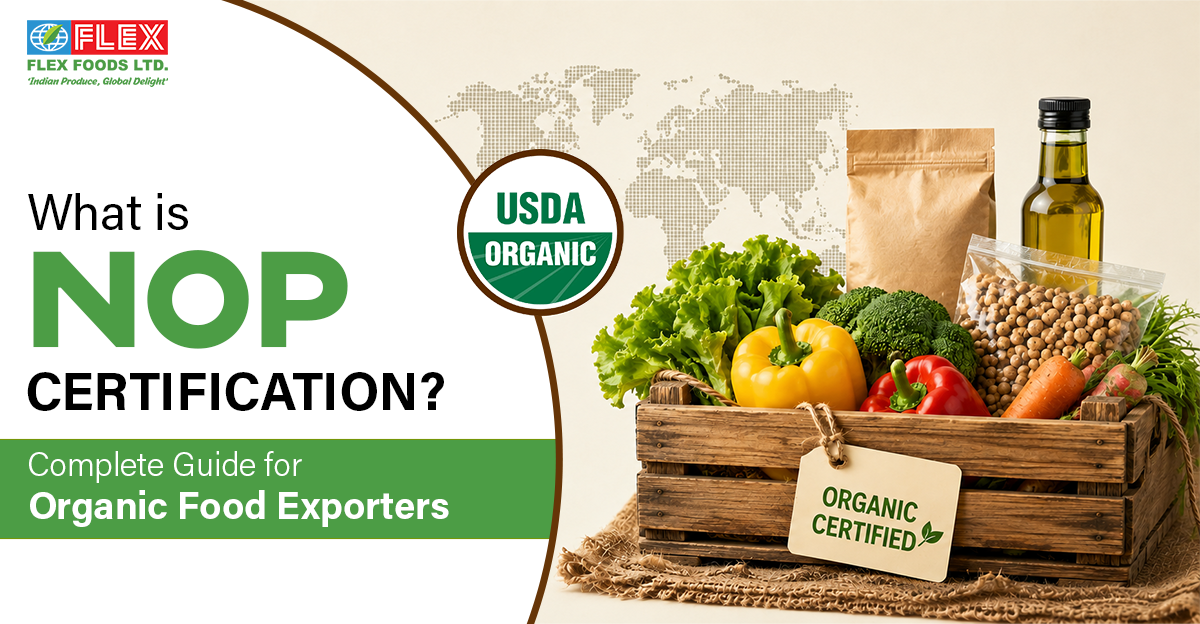
NOP certification refers to certification under the USDA National Organic Program, which establishes standards for organic agricultural products sold or represented as organic in the United States. For Indian food exporters, NOP compliance is important when exporting eligible organic products to the U.S. market. The certification framework helps ensure that organic claims are supported by documented production and handling practices. Exporters should understand that compliance is linked to both product integrity and market expectations.
Certification requirements do not remain the same for every business. They depend on the product category, supply chain structure, processing activities, labeling claims, and applicable regulations. A producer exporting organic spices may face different compliance obligations than a processor exporting frozen organic vegetables. Businesses should therefore evaluate their operations carefully before beginning the certification process.
What Is the USDA National Organic Program?
The USDA National Organic Program is the official regulatory framework for organic agricultural production, handling, labeling, and certification in the United States. It establishes standards that define how organic products are produced, processed, and represented in the marketplace. These standards help maintain consistency across the organic supply chain. They also support consumer confidence in organic labeling claims.
Organic standards are important because they create a common benchmark for producers, processors, certifiers, and buyers. The program protects organic integrity by requiring documented practices and independent verification through accredited certifying agents. USDA-accredited certifiers review operations, conduct inspections, and assess compliance with applicable organic requirements. Their role is central to maintaining credibility within the organic certification system.
Learn more about USFDA Registration
What Is NOP Certification?
NOP certification means that an operation has been certified by a USDA-accredited certifier as complying with applicable USDA organic requirements. The certification may apply to farms, processors, handlers, exporters, or other operations involved in organic products. It verifies that the certified activities meet the standards established under the National Organic Program. Certification is not self-declared and requires independent review.
Food exporters should understand NOP certification requirements before marketing products as organic in the United States. Buyers often request certification documents, product listings, and traceability records during supplier evaluation. A clear understanding of the certification scope helps prevent labeling or market-access issues. Early planning also reduces delays during certification review.
Is NOP certification the same as a USDA organic certificate?
In practical business use, the terms are often used together because a successful NOP certification process results in a USDA organic certificate issued by a USDA-accredited certifier. However, exporters should focus on the underlying certification status and approved scope rather than terminology alone. The certificate reflects the certifier’s decision that the operation complies with applicable NOP requirements. Buyers usually review the certificate along with supporting product and compliance records.
Why Is NOP Certification Important for Food Exporters?
Helps Meet U.S. Organic Requirements
Products marketed as organic in the United States must comply with applicable USDA organic requirements. NOP certification provides documented evidence that the operation has been reviewed against those standards. Exporters can use certification records to support buyer inquiries and regulatory expectations. Proper certification reduces the risk of non-compliant organic claims.
Supports Buyer and Importer Confidence
Importers frequently assess supplier traceability, supply-chain transparency, verified organic practices, and documentation quality. Certification creates a structured system for maintaining these records. Buyers generally prefer suppliers that can provide clear and consistent compliance evidence. Strong documentation also supports smoother commercial transactions.
Supports Access to the U.S. Organic Market
NOP certification is commercially significant because many U.S. buyers require certified suppliers for organic sourcing programs. Certification does not guarantee market access or sales success. It does, however, help exporters participate in organic procurement opportunities. Businesses without appropriate certification may face restrictions when marketing products as organic.
Strengthens Brand Credibility
Verified certification can strengthen trust with international buyers, retailers, and food manufacturers. Organic certification demonstrates that the operation follows documented procedures subject to independent oversight. Credibility is especially important in export markets where buyers may not have direct visibility into production practices. Consistent compliance can support long-term customer relationships.
Is NOP Certification Required for Exporting Organic Food from India to the USA?
Indian exporters should not assume that NPOP certification alone is sufficient for U.S. organic market access. The USDA ended its recognition agreement with APEDA in 2021, and Indian operations seeking USDA organic certification generally need to work with a USDA-accredited certifier. Exporters should verify current requirements before shipping products to the United States. Regulatory assumptions can create significant commercial risk.
Certification requirements can vary based on the product, operation, supply chain, and current regulations. Businesses should confirm requirements with an accredited certifier and the relevant authorities before exporting. This verification is particularly important for processed products and multi-stage supply chains. Early confirmation helps avoid shipment delays, relabeling costs, and buyer disputes.
NOP Certification vs NPOP Certification: What Is the Difference?
NPOP provides standards, certification systems, accreditation criteria, and the India Organic logo framework. It plays an important role in India’s organic certification ecosystem and certain export markets. NOP focuses specifically on compliance with U.S. organic requirements. Exporters should evaluate both systems carefully when planning international organic trade.
The two programs are related to organic production but are not automatically interchangeable. A business certified under one system should not assume acceptance under the other system without confirmation. Buyers may request specific certification based on destination-market requirements. Understanding this distinction is essential for export planning and labeling compliance.
Who Needs NOP Certification?
NOP certification may be relevant to organic farms, producers, food processors, manufacturers, handlers, packers, traders, exporters, and supply-chain partners involved in organic products. The need for certification depends on the activities performed by the business. Operations that process, handle, or market products as organic are more likely to require certification. Supply-chain mapping is therefore an important first step.
What Types of Food Products Can Be Covered Under NOP Certification?
NOP certification may apply to organic fruits and vegetables, organic frozen foods, organic herbs and spices, organic grains and cereals, organic ingredients, organic processed food products, and organic ready-to-cook products. Eligibility depends on the product composition and applicable organic requirements. Exporters should verify whether each product falls within the requested certification scope. Product listings on the certificate are especially important for buyers.
For processed or frozen organic food exports, businesses may need to demonstrate approved organic ingredients, supplier documentation, segregation from non-organic products, traceability systems, processing controls, and proper labeling. These controls help maintain organic integrity throughout manufacturing and storage. Detailed records are often reviewed during inspection and certification assessment. Exporters should avoid assuming that all products within a company portfolio are automatically covered by certification.
In international ingredient trade, product quality and compliance frequently work together. Buyers sourcing organic ingredients may also evaluate processing practices and supply-chain transparency. Products such as freeze-dried fruits are often sold into premium ingredient markets where documentation and traceability are closely reviewed. Exporters should therefore align commercial quality systems with organic compliance systems.
Frozen fruit exports also illustrate the importance of scope-specific certification management. Buyers purchasing IQF mango for food manufacturing may request confirmation that the certified operation covers the relevant processing and handling activities. Accurate product listings and batch-level traceability support these commercial discussions. Clear documentation reduces uncertainty during buyer qualification.
Vegetable ingredient exports may involve similar expectations. Buyers sourcing freeze-dried sweet corn can request supplier certificates, ingredient specifications, and traceability records before approving commercial shipments. Exporters should maintain organized documentation for each certified product category. Product-specific compliance management strengthens buyer confidence and operational readiness.
NOP Certification Requirements for Food Exporters
Food exporters seeking NOP certification are generally expected to maintain a documented Organic System Plan. This plan describes production or processing activities, inputs and ingredients, handling procedures, recordkeeping systems, and traceability controls. The document should reflect actual operating practices rather than generic statements. Certifiers rely heavily on this information during compliance review.
Exporters must also verify organic ingredients and permitted inputs used in certified products. Traceability records may include supplier certificates, batch records, production records, inventory records, and shipment documentation. Operations should implement controls that prevent contamination and commingling with non-organic products. Certification includes review of records and inspection by a USDA-accredited certifier.
NOP Certification Process: Step-by-Step
The certification process usually begins with identifying the correct certification scope, such as producer, processor, handler, exporter, or a combination operation. The business then selects a USDA-accredited certifier and prepares the Organic System Plan with supporting records. The application package generally includes business details, product information, ingredient information, process descriptions, and traceability documentation. Complete applications usually move through review more efficiently than incomplete submissions.
After submission, the certifier reviews the documents and may conduct an on-site inspection to verify compliance. If noncompliance issues are identified, the operation is normally asked to provide corrective actions and supporting evidence. The certifier then makes the certification decision based on the review findings. Certified operations must continue annual updates, inspections, surveillance activities, and ongoing recordkeeping.
Read more about the OU Kosher Certification
Documents Required for NOP Certification
Exporters should prepare business registration details, product lists, ingredient lists, supplier certificates, the Organic System Plan, process flow diagrams, production records, cleaning procedures, storage records, segregation records, traceability records, product labels, and export documentation where applicable. Organized records help reduce delays during certification review. Many certifiers provide application checklists to help applicants prepare complete submissions. Document control is a critical compliance activity.
Required documents may vary by product, operation type, certifier, and supply-chain structure. Multi-site operations often need additional facility-level records and supplier documentation. Processed products may require formulation details and ingredient approvals. Exporters should confirm document requirements directly with their selected certifier.
Detailed Document Checklist
- Business registration documents: Legal entity records, licenses, and tax registrations.
- Product list: All products proposed for certification, including product names and pack sizes.
- Ingredient list: Complete ingredient details with organic status and supplier information.
- Supplier certificates: Current organic certificates for suppliers of certified ingredients.
- Organic System Plan: Description of production, processing, handling, storage, and recordkeeping procedures.
- Process flow diagrams: Step-by-step manufacturing or handling flow from receipt to dispatch.
- Production records: Batch sheets, production logs, and processing records.
- Cleaning and sanitation procedures: Documented cleaning methods and verification activities.
- Storage and segregation records: Evidence of separation between organic and non-organic materials.
- Traceability records: Lot coding, inventory movement, and shipment linkage records.
- Product labels: Draft or final labels showing organic claims and certification information.
- Export documentation: Commercial invoices, packing lists, shipping records, and related export documents where applicable.
How Long Does NOP Certification Take?
The certification timeline depends on the completeness of documents, complexity of operations, number of products, supply-chain verification requirements, inspection scheduling, and corrective actions. Operations with well-organized records generally move through review more efficiently. Complex processing facilities may require additional assessment and supplier verification. Exporters should avoid making shipment commitments before certification status is confirmed.
Certifiers may also have different review schedules and inspection capacities. Seasonal agricultural operations can experience timing variations depending on harvest periods and inspection availability. Prompt responses to certifier questions can help prevent unnecessary delays. Businesses should discuss expected timelines directly with the selected certifier.
What Is the Cost of NOP Certification?
NOP certification costs vary based on the type of operation, number of facilities, product range, inspection requirements, certification body fees, and documentation support needs. Small operations usually have different cost structures than multi-site processing companies. Travel and inspection expenses may also affect the overall cost. Exporters should budget for both initial certification and ongoing annual compliance activities.
Additional expenses can arise from corrective actions, label reviews, supplier verification, and record-management improvements. Companies with complex supply chains may require more extensive compliance support. Cost planning should therefore include operational readiness activities as well as certifier fees. Contact a USDA-accredited certifier for a customized certification quotation.
Common Challenges Food Exporters Face During NOP Certification
Exporters often encounter incomplete supplier documentation, weak traceability systems, missing batch records, incorrect product labeling, unverified ingredients, poor segregation procedures, confusion between NPOP and NOP requirements, and inconsistent records across suppliers and processors. These issues can slow certification review and create corrective-action requests. Many problems originate from inadequate document management rather than intentional non-compliance. Early internal audits can help identify gaps.
Supply-chain complexity is a common challenge for processors that source ingredients from multiple suppliers. Differences in record formats and certification status can create verification difficulties. Training procurement, production, and quality teams helps improve consistency across departments. Strong communication with suppliers is equally important.
How Food Exporters Can Prepare for NOP Certification?
Exporters can improve readiness by conducting a certification-readiness audit, mapping the complete supply chain, verifying supplier documentation, creating product-level traceability, reviewing labels before printing, training production and quality teams, maintaining updated records, and reviewing requirements with an accredited certifier. Preparation should begin well before the intended export date. Internal responsibility assignments help ensure that records remain current.
Management commitment is important because certification affects procurement, production, warehousing, labeling, and logistics functions. Regular internal reviews can identify process changes that require updates to the Organic System Plan. Supplier approval programs should be maintained continuously rather than only during audits. Consistent preparation reduces certification risk and operational disruption.
Read more about the Sustainability in Food Processing
How Flex Foods Supports International Food Buyers?
Flex Foods supports international food buyers by supplying high-quality processed and frozen food products backed by strict quality control systems and hygienic manufacturing practices. The company focuses on clean processing facilities, controlled production environments, food safety procedures, and export-oriented operations that help maintain product consistency across global markets. Its portfolio includes value-added products such as freeze-dried fruits, IQF mango, and freeze-dried sweet corn for retail, food-service, and ingredient applications. International buyers also benefit from documented quality processes, traceability practices, and relevant certifications that support reliable sourcing, long-term supply relationships, and confidence in export-quality food products.
Conclusion
NOP certification is the USDA’s organic certification framework for products represented as organic in the United States. For eligible organic food exports, certification can be an important part of meeting buyer and regulatory expectations. Indian exporters should clearly understand the distinction between NOP and NPOP before planning U.S. organic exports. Assumptions about equivalence can create compliance and commercial risks.
Successful certification depends on accurate documentation, traceability, inspection readiness, and ongoing compliance management. Exporters should work closely with USDA-accredited certifiers and maintain strong internal control systems. Regular review of supply-chain records and labeling practices helps support continued compliance. Certification requirements should always be confirmed with the relevant certifier and authorities before export.
Frequently Asked Questions
What is NOP certification?
NOP certification is certification under the USDA National Organic Program verifying compliance with applicable U.S. organic requirements.
What does NOP stand for?
NOP stands for National Organic Program.
Is NOP certification mandatory for exporting organic food to the USA?
It is generally required when products are marketed as organic in the U.S. market, subject to applicable regulations.
Is NPOP certification valid for the U.S. market?
NPOP certification should not be assumed to replace USDA organic certification for U.S. market access.
Who issues NOP certification in India?
NOP certification is issued by USDA-accredited certifying bodies operating in India.
How do Indian food exporters obtain USDA organic certification?
They typically apply through a USDA-accredited certifier and complete the required review and inspection process.
What documents are required for NOP certification?
Typical documents include business records, product lists, supplier certificates, the Organic System Plan, production records, and traceability records.
How long does NOP certification take?
The timeline varies according to operational complexity, document completeness, inspection scheduling, and corrective actions.
What is the difference between NOP and NPOP?
NOP is the U.S. organic program, while NPOP is India’s organic certification framework.
Can processed and frozen foods be certified under USDA organic standards?
Yes, processed and frozen foods may be certified if they meet applicable organic requirements.
Is a transaction certificate required for organic food exports from India?
Requirements can vary depending on the export program and applicable Indian regulations.
How can food exporters maintain NOP compliance?
They should maintain updated records, follow the Organic System Plan, complete annual reviews, and address compliance issues promptly.
